Golf’s biggest newsmakers Pt. 1
The most pivotal golf shot played in 2025
There are a number of nominees but the one that stands out the most is the mindboggling 67-foot putt J.J. Spaun sunk on the 18th green of the final round at this year’s US Open. The final hole at Oakmont is no easy matter and Spaun after reaching the green in the regulation stroke knew full well he would need no more than two putts to secure a one-shot win over Robert MacIntyre.
Remarkably, Spaun had started the final round just one shot back but his direction was anything but up the scoreboard. The 35-year-old proceeded to bogey five of his first six holes and it appeared to many that his opportunity to claim the title was slipping away as he trailed by four shots as late as the 12th hole.
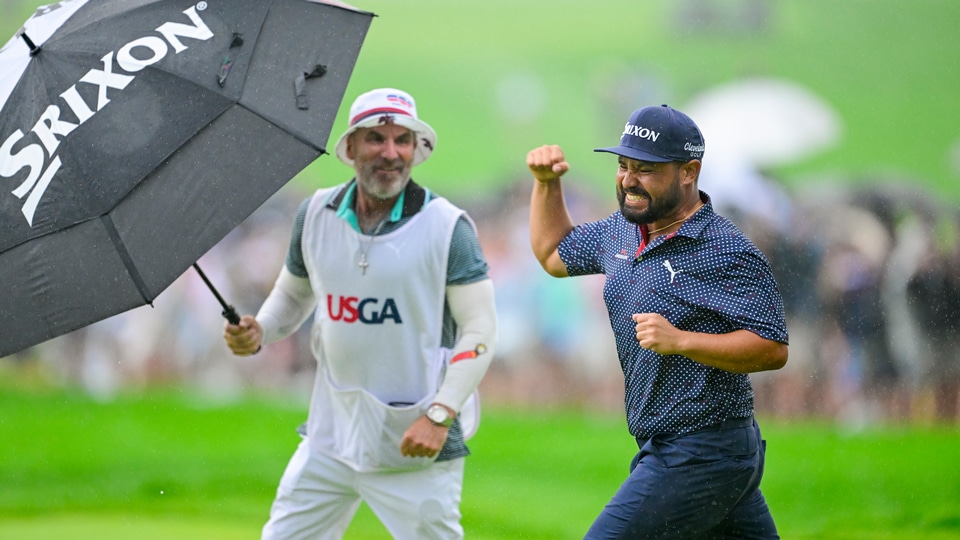
Spaun had other plans — from the 7th hole onward he would birdie four holes, against just one bogey. When Spaun reached the penultimate hole he raised the level of his game with a laser-like drive that reached the green on the short par-4. Two putts later and he held a one-stroke margin going to the final hole.
Spaun’s tee shot found the 18th fairway and while his approach did get to the green – his ball rested 67-feet away.
Few could ever expect — including Spaun – what happened next. The longish putt broke considerably from left-to-right and the speed was gauged correctly. When the golf ball tumbled into the hole, Spaun and caddie Mark Carens embraced and as he left the green Spaun raised his right hand high in the air as the ensembled gallery roared to the max.
Every angle of J.J. Spaun’s putt to win the U.S. Open 👏 pic.twitter.com/13SW4ngCl7
— PGA TOUR (@PGATOUR) June 16, 2025
The Open at Oakmont had issues with wet turf conditions that impacted play during the final round. Spaun showed his wherewithal to remain focused and keep plugging away. To birdie the two final holes when all was on the line goes beyond remarkable.
No matter what Spaun does for the remainder of his career the 67-foot bomb putt he sunk at Oakmont will forever be etched in the sport’s history.
New leaders at the top — PGA Tour’s Brian Rolapp
The biggest news from 2025 did not come solely from events that happened on the course. Key new leaders emerged and the likelihood for more sweeping initiatives seems probable on both fronts.
Plans were put in motion to phase out Jay Monahan as the PGA Tour’s Commissioner and the name of Brian Rolapp emerged as CEO. The move was announced June 25, 2025. The ascension of Rolapp, who previously served as Chief Media and Business Officer for the National Football League (NFL), demonstrated a desire to go beyond the initial moves made internally by the PGA Tour to strengthen its position going forward in professional golf.
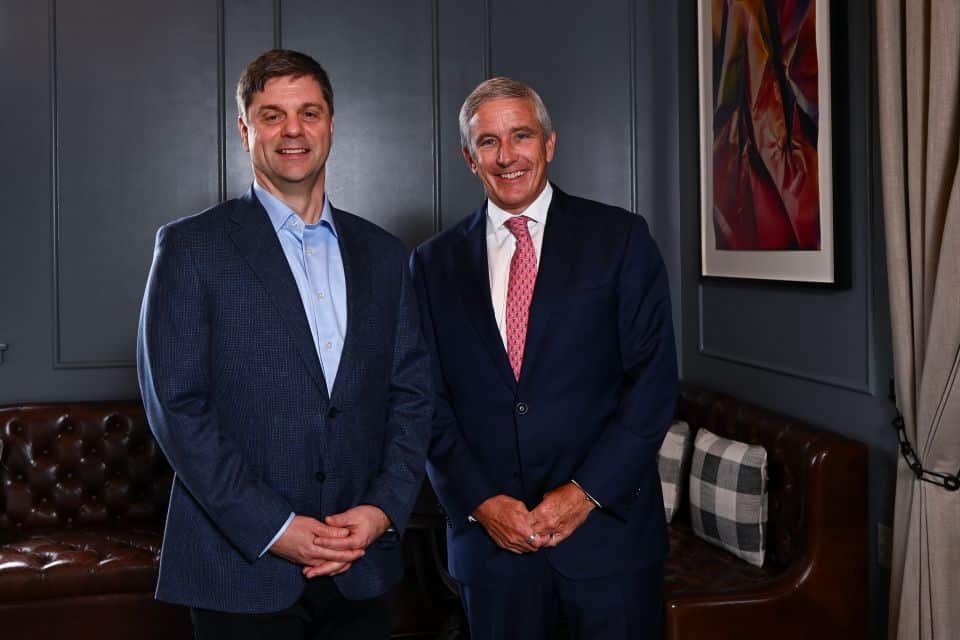
Rolapp has expressed interest in revamping the Tour’s weekly schedule of events. The focal point rests on three specific target areas — parity, scarcity and simplicity. Rolapp’s NFL involvement is now directed at achieving a brighter and more impactful light on the Tour’s elite players.
That can translate into fewer events with guaranteed fields encouraging sponsors to both remain and increase their financial commitment.
The 53-year-old wasted little time in outlining the broad reach he wants the PGA Tour to achieve. Monahan’s rise to Commissioner following the 22 years of his predecessor Tim Finchem has clearly indicated a desire to bring “new eyes” to the table. The PGA Tour has been an insular operation and maintained a strict promotions from within model.
Rolapp’s emergence is the clearest indicator that the organization is seeking a new direction and a new presentation in how it sees itself in the global modem sports economy. In short, Rolapp wants more than change – he seeks structural improvements for a product that no longer has a marquee player like Tiger Woods at the top.
Rolapp stated his thoughts to Golfweek‘s Eamon Lynch succinctly — “I think the focus will be, as I mentioned, to create events that really matter.” The Tour has been operationally about creating more events to satisfy the broader number of constituents (players). Rolapp’s statement is clear broadside to that operating method and clearly puts in motion his laser-like focus that less will be actually more.
In short – those under the PGA Tour umbrella should heed two words likely to happen — buckle up.
New Leaders at the Top — LPGA Tour’s Craig Kessler
The LPGA Tour hired Craig Kessler in May 2025, as the 10th commissioner and replaced interim commissioner Liz Moore (Jan-July 2025) and the permanent commissioner Mollie Marcoux Samaan (2021-2025).
Kessler, previously served as Chief Operating Officer for the PGA of America and his hiring indicates a clear need for the fledgling women’s pro golf circuit to go beyond the near total invisibility of its organization in the global sports arena.
Unlike the PGA Tour, the LPGA product receives scant media attention and even less consumer interest. Other female sports stars have emerged in recent years with the likes of Kaitlin Clark, Simone Biles, Serena Williams, Marta Vieira da Silva, to name just a few.
The women’s golf side has operated in near total invisibility. Former world ranked number one Nelly Korda demonstrates high golf skills but her personality has neither generated fan nor commercial interest.
The 40-year-old new commissioner is faced with a sports landscape in which women’s pro golf has languished since the departure of an earlier commissioner (2010-2021) Mike Whan who left to be CEO of the USGA. Even during Whan’s reign, women’s pro golf was only keeping its head barely above the ultra-competitive sports water line.
Kessler has quality players under the LPGA umbrella — the emergence of Jeeno Thitikul is one example of the skill level possessed. But the need for a clear USA star who can move the audience needle has been lacking for quite some time.
Kessler will need to enhance the media visibility of the LPGA. The Tour has various events globally but it fights to achieve even the barest minimum of exposure.
The new commissioner has expressed a desire to stage a women’s major championship in Asia. All of the current five are either in the USA or Europe. He’s also taken action in forming an alliance with Golf Saudi — the group financed by the Saudi’s Public Investment Fund (PIF). The broader issue is will those on the LPGA Tour wish to be connected to a country with a long history of human rights issues — particularly to females in that country? Clearly, that has not stopped or slowed interest from other female sports organizations so the LPGA in moving in that direction believes it must do so out of financial gain.
Nonetheless, the statement made to me years ago on the LPGA still remains in my memory banks. When I asked this informed golf connected individual what holds back the organization he was quick to say the following: “You can’t take a “B” product into an “A’ market.”
Suffice to say, Kessler’s challenge will be a significant one. Attempting to push the LPGA into an “A” product that cements itself in various “A’ markets.
Royal Portrush’s brilliant encore performance
Each year the four major championships in men’s professional golf garner high visibility and attention. They are the key events that determine a player’s stature and ultimate legacy in the sport.

In 1951, the R&A opted to stage The Open Championship at Royal Portrush in Northern Ireland. It was the first time the oldest event in the sport’s history would be hosted outside of Scotland and England. 68 years later the event returned to Royal Portrush with a spectacular total turnout of 238,000 – the second highest number outside of St. Andrews. To make matters more special – an Irishman named Shane Lowry took home the famed Claret Jug with a resounding six-shot victory.
Just six years later, the R&A decided to return to Royal Portrush for the 2025 championship and the momentum from the past resurfaced and approximately 278,000 attended the event.
In preparing the course for the ’19 event — architects Tom Mackenzie and Martin Ebert carried out significant updates and a redesign of the Dunluce Links at Royal Portrush. Minor updates took place by the same tandem prior to the ’25 event.

Related: Behind the Architectural Curtain – Royal Portrush (Dunluce)
This year’s Open was assisted by the stellar play of world-ranked number one player Scottie Scheffler who lifted the Claret Jug with his four-shot triumph. Scheffler took control after a second 64 and never looked back.
After staging its third Open, two in just the last six years, it appears Royal Portrush will now be in the R&A future plans with another visit in the very near future.
The Cabot golf brand — ever growing
When Cabot Links opened in 2012 the Cape Breton Island layout in Nova Scotia, the seeds for what would soon blossom were placed. The first “links” course — built on a former coal mine and designed by Canadian Rod Whitman emphasized a combination of aerial and ground game golf skills. The 18-hole layout received laudatory reviews.
A second course, designed by Ben Crenshaw and Bill Coore, and located nearby called Cabot Cliffs opened in 2015. The positive reviews kept building and building. What was once a sleepy and somewhat depressed Inverness town, had now catapulted itself into a global golf force.
The man behind the original effort — Ben Cowan-Dewar — a Toronto-born Canadian with a deep affection for the sport, wanted to showcase a design that harkens back to the days of golf’s starting point in Scotland.
Ben’s desire to grow the Cabot brand was aided by a close connection to Mike Keiser — the man responsible for the emergence of the renowned Bandon Dunes facility in Oregon along the Pacific coastline. Both men have deep kindred feeling for the spirit of the game as originally intended and they formed a business partnership.
The Cabot brand now includes various golf properties – both in the US and elsewhere. The pair were instrumental in buying the former World Woods property in Florida. The 36-hole layout, called Cabot Citrus Farms, was updated and includes the newly fashioned Karoo and The Roost 18-hole layouts. Two shorter courses are also part of the golf offerings.
An international presence was secured when taking ownership of the former Castle Stuart property in Scotland in June 2022. Now called Cabot Highlands there are plans for a second course to be designed by acclaimed architect Tom Doak.
Next up in the growing portfolio was Cabot St. Lucia and the Point Hardy Golf Club. Once again, the duo of Crenshaw and Coore were hired and in December 2023 the 18-hole layout opened. The 375-acre property has an 18-hole course provides mesmerizing views of the adjacent Caribbean.
The Cabot brand ventured next to France and the purchase in June 2024 of two existing 18-hole courses on one property — now called Cabot Bordeaux. The 500-acre location features original designs from Coore and Whitman and both courses will be updated by the respective architects.

In the pipeline is another course – this one based in British Columbia, Canada called Cabot Pacific with tentative plans to open in 2026. Whitman will be the architect for that stunning property abutting Mount Mackenzie.
And the Cabot brand will also be involved with the existing Lufoten Links in Norway. The spectacular layout came into being in the summer of 2015. The purchase was completed in 2024 and the project will include updating existing amenities to provide for a destination of special note.
The secret of Cabot’s success to date? Following the advice of Crenshaw who outlines the three key elements — great land coupled with great architecture and supported by great ownership.
What’s next? Stay tuned.
Tiger now 50 – what’s next?
The 15-time major winner turned 50 on December 30 and his future remains uncertain but the fanfare of who he is remains high among interested observers.
Woods has had seven back surgeries in total, including four microdiscectomies (2014, 2015, 2021), a major spinal fusion (2017), and most recently, a lumbar disc replacement in October 2025, addressing persistent pain and mobility issues in his lower back
Tiger did address media during his event in the Bahamas a few weeks back and while he stated he has received the green light in terms of chipping and putting golf balls, the time line for any sort of return to competitive golf remains anyone’s guess.
Is another comeback possible?
It depends upon what the nature of a comeback means and entails. Tiger stated his definition at this moment is just returning to play golf for the joy in simply playing. In regards to returning to competitive play, Woods was unable to even speculate until he can thoroughly assess his full body motion when taking full swings. When that might be is unknown.
Certain basic realities still remain in question. Can Tiger even walk without lingering pain? Granted the Champions Tour does permit players to take a power cart and the events are generally only 54 holes.
Beyond the personal intersection with competitive golf, Tiger has taken a proactive role in shaping the future of the PGA Tour. His involvement is more than ceremonial and he has been especially mindful of what any future resolution can mean for those playing at the elite level, the networks and those following the game in the fan base.
His last win came at the October 2019 Zozo Championship in Japan. His last major victory came that same year several months earlier when winning his fifth green jacket at Augusta.

Speculation has been a constant news feed with various people weighing in whether Woods will seek to play in Champions Tour events. John Cook, a former Tour player and now an analysis with Golf Channel, has speculated that given the competitive fires that burn within Woods he will play when everything sorts out.
What is clear is that interest in what Tiger Woods does or does not do remains high. That interest will likely not diminish with the new yeart ahead.