
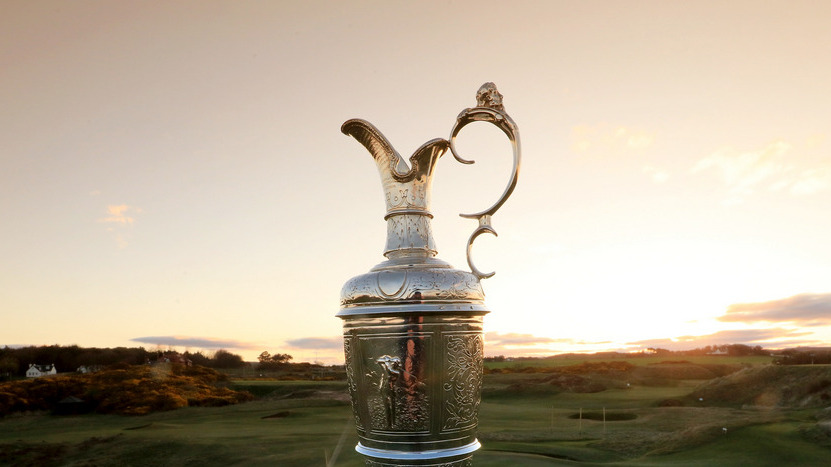
PORTRUSH, NORTHERN IRELAND. Ask golfers what a mulligan is and the answer will likely say the following two words – do over. Championship golf doesn’t provide for such “do over” moments but one can only imagine if such situations did happen what might have happened instead of what actually took place.
In the post World War II era the Open Championship has seen clear instances in which what appeared likely was then turned on its head.
Here are a few such moments and what a “do over” might have meant for the outcome of that specific Open. And how golf history would have been altered.
For the golfers who missed such an opportunity in taking home the coveted Claret Jug the memory of such a failure remains ever fresh. But with one golfer’s pain becomes another man’s joy.

***
The Nicklaus Fumble / ’63 Open
Playing in just his second Open Championship, Jack Nicklaus came down the stretch of the final round with a very good opportunity to snare the Claret Jug.
If the Golden Bear parred the final two holes he would claim the title at age 23. However, two consecutive bogies at the 17th and 18th holes pushed Nicklaus out of the picture finishing one shot behind eventual winner Bob Charles and runner-up Phil Rogers.
Nicklaus remembers vividly what happened but believed that situation proved to be a crucial learning point in his then blossoming pro career.
Learning how to deal with similar situations that would come in the future is what paved Jack’s road to win a remarkable 18 major victories. The 1963 Open proved to be a lasting lesson.
The Sanders yip / ’70 Open
Golf can be a cruel game and nothing shows that more than when a golfer is near to the hole on the green and then for whatever reason the twitching of muscles in the hands becomes apparent and the final destination of the golf ball is anywhere other than the bottom of the cup.
When Doug Sanders arrived at the 18th during the final round of the ’70 Open at St. Andrews the situation was clear. A final par to provide the needed margin of one shot over Jack Nicklaus at the Old Course.
The resulting stab by Sanders was painful to watch. A golden opportunity forever missed. When asked how often he thought of the botched stroke Sanders was blunt — everyday.
The Jacklin three-putt / ’72 Open
As the 1972 Open was drawing to a close it appeared Englishman Tony Jacklin was about to snare a second Claret Jug (winning his first in 1969) and with that a third major title.
At the penultimate hole — Muirfield’s par-5 17th — Jacklin had 15 feet for birdie and he watched as playing partner Lee Trevino could not get his golf ball just off the back of the hole in four shots. Then in a sudden moment equivalent to an earthquake, Trevino holed his chip shot for a par.
Jacklin boldly played his birdie putt past the hole by nearly 3 feet. His attempt for par never touched the hole. Amazingly, what looked like a certain Jacklin lead going to the final hole had him trail by one.
Jacklin fumbled at the final hole with a bogey and Trevino walked off with a par and a defense of his title.
That specific shocking event pushed Jacklin off the ladder of elite level golf – never to return again. One can only imagine if Tony had a mulligan what could have happened.

The Nicklaus missed putt / ’77 Open
The “Duel in the Sun” between the two best players in golf was in full display with Jack Nicklaus and Tom Watson commanding center stage.
The two had outdistanced all others and the championship would be settled between only them.
When they arrived at the par-5 17th — it was likely a birdie would be the minimum needed by both in order to keep their respective chances alive.
Nicklaus missed the green left and after a skillful chip was left with a six-foot putt for birdie which he uncharacteristically missed. Watson had reached the green in two shots and was able to secure a birdie for a one-shot lead with a single hole to play.
If Jack had made the putt the strategy for the final hole would likely have changed. Given his failure to hole the putt, Nicklaus opted for a driver on the 18th and promptly missed the fairway left. Both men would make a final hole birdie but the nature of the outcome was dictated by how the 17th was played. For Jack a missed putt that undoubtedly, he would have liked to have replayed.
Watson’s “Road Hole” two-iron / ’84 Open
Tom Watson came to the ’84 Open at St. Andrews with a clear mission – win at the iconic course and secure a three-peat success in winning the game’s oldest major.
The man standing between him and that goal was Seve Ballesteros. The Spaniard played the final holes with a score of 4-3 — finishing with a superlative birdie at the 18th and then fist pumping in utter joy.
Watson needed to finish strongly to secure another Open title but when he reached the demanding Road Hole his tee shot left him a lengthy approach to the devilish green. Watson opted for a two-iron and the shot flew wide and right of the putting surface and ultimately ended up alongside the stonewall that serves as the boundary for the hole.
Watson would leave the penultimate hole with a bogey and his concluding par at the 18th meant a tie for the runner-up position with German Bernhard Langer.
The Shark sinks / ’89 Open
The striking figure of Greg Norman competing was a compelling visual. The Aussie’s svelte athletic bod and his blond locks blowing made for an indelible image.
Norman had won the 1986 Open at Turnberry for his first major triumph. At the ’89 Open at Royal Troon, Norman secured one of three positions in the first ever four-hole aggregate playoff with an outstanding final round score of 64.
The Shark started the playoff with an opening birdie and it appeared the momentum was there for a Norman conquest.
But, as happened throughout his career, a sudden turn of events would come forward and ultimately harpoon the Shark.
Tied with Mark Calcavecchia in the final hole of the playoff at Royal Troon’s 18th hole, Norman opted to hit driver, when a lesser club would have sufficed, and found the only obstacle that could derail him – a single deep fairway bunker. Norman then played himself out of the hole and all the effort he had demonstrated to secure a position in the playoff was again for naught.
Cook’s goose cooked / ’92 Open
The reason why they play 72 holes in championship golf is because nothing is ever over — until it’s over.
American John Cook found that out the hard way — he had the late lead at the ’92 Open at Muirfield and after reaching the par-5 17th in two shots the Claret Jug all but seemed to be in his possession.
Cook’s effort from 40 feet away finished just three feet away for birdie. A score of birdie four would give him a two-shot lead with one to play. He missed the putt and then ended the round with a final hole bogey and what looked like victory turned into a runner-up position to Nick Faldo who finished 4-4 to claim his 2nd Open Championship title.
Van del Velde’s collapse / 1999 Open
Among all major championship finishes the conclusion of the 1999 Open at Carnoustie remains either at the top or easily among the top 2-3.
The Frenchman came to the final demanding par-4 hole with a three-shot lead.
Eschewing caution he opted for a driver and he safely avoided trouble. However, instead of playing safely back to the fairway, Van de Velde played towards the green and his ball bounced wildly back into the high grass. His next shot barely moved forward and found the Burn that fronts the green. For a moment he was tempted to wade into the water and extricate his ball.
Peter Aliss during the BBC broadcast made an apt comment on the inane actions and said correctly, “Give him a large brandy and mop him down.”
Van de Velde would make a triple bogey pushing him into a playoff which he would lose to Paul Lawrie (Justin Leonard was also in the playoff) who had started the day a record 10 shots behind.
For Van de Velde his 15 minutes of fame came to an end. Amazingly, he still remains defiant his strategy was sound. Sadly, one can work with ignorance but never help eternal stupidity.
Watson’s whiff / “09 Open
The most amazing of golf stories nearly happened when 59-year-old Tom Watson nearly captured a record tying sixth Open title at Turnberry.
Up to that point no golfer past the age of 48 had ever won a major title.
And, Watson was seeking to replicate his amazing triumph 32 years earlier when he bested Jack Nicklaus in the epic “Duel in the Sun.”
Watson came to the final hole needing a par to secure the Claret Jug. After a perfect tee shot his 8-iron approach hit hard into the green and rolled off the rear side.
If Watson ever needed a mulligan, it would come for either his third or fourth shots. The birdie try was hit too boldly leaving him no less than eight feet for par and the title. His effort was feeble and never made it to the cup. Watson would go into a playoff but his age and nerves were no match for winner Stewart Cink.
The fairy tale of epic golf proportions, that seemed so imminent, was dashed for good.

Related: The Open Championship Fact Sheet

M. James Ward
A long-time member of both the GWAA and MGWA. The 68-year-old has covered all facets in golf since 1980 — including reporting on over 100 major championships and 13 Ryder Cup matches. His writings have appeared in various outlets. On a personal level, has played over 2,000 courses globally and is lead reviewer for Top 100 Golf Courses.
Previously served for 17 years as national course rating panelist for Golf Digest. Has also personally competed in USGA Championships. Resides in the metro New York City area with his wife Celeste. Favorite quote paraphrased for golf — “You are what your golf score says you are.”