

Mallets now dominate tour use. Today’s Golfer reports that more than 90 per cent of players inside the top 50 of the Official World Golf Rankings now use a mallet putter, and its 2026 test of 110 models placed two TaylorMade Spiders at the top of the overall rankings. The best blade finished 12th.
Club golfers still have a choice: blades won the Open Championship and the Valspar in 2026, while the testing data shows they hold their own in feedback and looks. The choice comes down to what you need help with, and how your stroke moves.
Head size, MOI and forgiveness
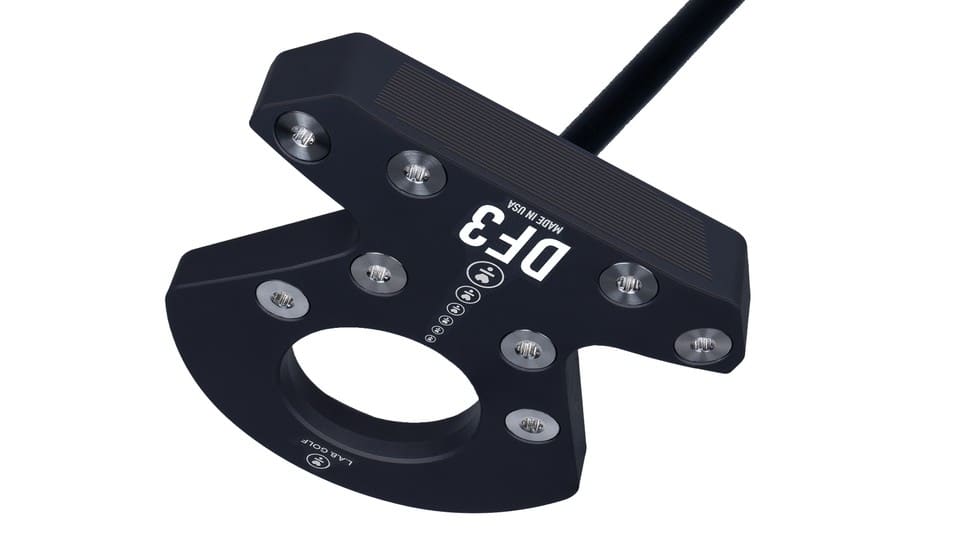
A mallet has a larger head than a blade, and the extra footprint lets manufacturers push mass out to the perimeter and towards the rear of the head. That raises the moment of inertia (MOI), so the face resists twisting when the ball is struck away from the centre. GOLF.com puts the practical benefit simply: even off-centre strikes with a high-MOI mallet tend to roll relatively straight and cover nearly the intended distance.
The larger head also gives designers room for alignment aids, from long contrasting sightlines to arrows and framing shapes. On a narrow blade, alignment help is usually limited to a single line on the top edge.
Blades work differently. Heel-toe weighting, the idea Ping introduced with the Anser, adds stability to a compact head without turning it into a mallet. The trade is less forgiveness in exchange for a smaller profile and a more direct connection between strike and feel.
Tour usage from 62 per cent to over 90 per cent
Mallet use among the world’s best has risen quickly. GOLF.com reported that 62 per cent of the top 50 players used a mallet in 2022. Today’s Golfer’s 2026 figure is above 90 per cent. The two numbers cover different seasons and neither source publishes its player list, so they show a direction of travel rather than a controlled measurement.
Scottie Scheffler’s switch is the most cited example. He moved to a TaylorMade Spider in March 2024 and won nine times worldwide that year, including the Masters and the Players. GOLF.com lists Xander Schauffele, Jon Rahm, Rory McIlroy and Justin Thomas among other players who have moved to a mallet.
A 2025 thread on The Hackers Paradise forum claimed mallets accounted for 35 of 47 PGA Tour winners that season and that 41 of the top 50 used one. Those figures come from a forum participant’s compilation rather than an official database, and one reply in the same thread pointed out that blades winning roughly a quarter of events would mean they outperformed their share of the top 50. Treat the numbers as indicative.
What 2026 PGA Tour winners putted with
Golf Digest’s running list of every 2026 PGA Tour winner’s putter makes the mallet trend concrete. TaylorMade finished the season with 13 wins, the most of any manufacturer, and almost all of them came from the Spider Tour X family.
Other mallets featured heavily too. Wyndham Clark won the U.S. Open, the BMW Championship and the CJ Cup Byron Nelson with a Ping Scottsdale Tec Ally Blue Onset, gaining 12.573 strokes on the greens at the Byron Nelson. Cameron Young won the Players and the Cadillac Championship with a Scotty Cameron Phantom 9.5 prototype, and at Bay Hill Akshay Bhatia’s Odyssey Jailbird 380 Long helped him produce a strokes gained putting figure of 10.605, highest in the field.

Blades still won: Matt Fitzpatrick took the Valspar and the RBC Heritage with Bettinardi BB1-style DASS prototypes, needing just 25 putts in the final round at Innisbrook. Tom Kim won the Genesis Scottish Open with a Scotty Cameron TourType Timeless GSS. And Ryan Fox won the Open Championship with a Ping Anser 2D, the shape that defines the blade category, fitted with a 40-inch 8-iron shaft and 6.5 degrees of loft to suit his forward press. Fox posted 9.45 strokes gained putting, the week’s leading figure, and holed 458 feet of putts, the most of anyone that week.
Golf Digest records the putter and a putting statistic for each winner. It does not claim the putter caused the win, and neither should you.
How mallets and blades scored in the 2026 test
Today’s Golfer tested 44 mallets and 29 blades within its 110-putter test, scoring each in five categories: looks, alignment, stability, roll and feedback.
The TaylorMade Spider Tour topped the whole test at 90.0 per cent, finishing first in four of the five categories and tied fourth for looks. It scored 65 out of 70 for stability and 66 out of 70 for roll, the best roll result in the test. The Spider Tour X followed at 88.0 per cent and took first place for looks, ahead of every blade tested. The PXG Battle Ready II Torpedo, another large high-MOI head, was third at 81.4 per cent.
Digital Editor Rob Jerram gave the Spider Tour full marks. “Performance-wise, it is just fantastic, the Pure Roll [insert] feels great, and it gives you exactly that – it’s a pure roll again, and again, and again,” he said. “It is so super stable, and the alignment aid is fantastic.”
The best blade was the Ping PLD Anser at 76.0 per cent, 12th overall. The Scotty Cameron Studio Style Newport followed at 74.0 per cent, then the Mizuno Kyoto at 73.4 per cent and the Toulon Boston at 72.6 per cent. Every one of the top three positions overall went to a large mallet.
James Hogg, the magazine’s putters expert, still put the Anser in historical context. “The Anser goes down in history as one of, if not the greatest golf club of all time,” he said. “It’s instantly recognisable, and the fact that so many brands copied the Anser once the patent expired in 1984 shows just how trailblazing this putter was, and it continues to be in the blade category in 2026.”
Where blades still score well
Feedback is the clearest blade strength. The Mizuno Osaka scored 57 points for feedback, the best of any blade and tied fourth among all 110 putters. The PXG Torpedo shows the other side of the trade: its S-COR polymer filling 63 per cent of the internal cavity produced a soft feel that left it with a feedback score of 53, its weakest category, despite strong stability and roll.
Looks is the other area where blades compete. The PLD Anser tied first among blades for looks and tied second among all putters tested. Only the Spider Tour X beat it.

Stability is where the gap is widest. The most stable blades, including the Cobra 3DP Tour Grandsport 35 and the Mizuno Kyoto, sat well behind the leading mallets, and the Odyssey Ai-DUAL Double Wide 1/2 Ball only reached mallet-level forgiveness by adopting a wide body and a half-ball alignment aid that dragged its looks score down to 33.
The middle ground: compact mallets and wide blades
Golfers who find a Spider too bulky have options between the two extremes. The Bettinardi BB6.0, a compact fang-style mallet, finished sixth overall at 79.4 per cent, ranking tied fourth in the whole test for feedback and sixth for alignment, but only tied 11th among mallets for stability.
Scotty Cameron’s Studio Style Fastback 2 and Squareback 2 sit closer still to a blade. Testers found the Fastback performed like a blade with added forgiveness, scoring 53 for stability, while the Squareback 2 was recommended for golfers who like a Newport but want more stability. Both use the same Studio Carbon Steel insert as the Phantom range, so feel stays consistent across the family.
Neck and toe hang matter more than the label
The biggest misconception about mallets is that they only suit a linear stroke from back to through. Face-balanced heads, usually built with single-bend, double-bend or centre shafts, do favour a straighter path. But slant necks and plumber’s necks add toe hang, and the Spider Tour carries 29 degrees of it, the Spider Tour X 21 degrees. Scotty Cameron sells the Phantom 7 in a face-balanced 7, a plumber’s-neck 7.2 and a jet-neck 7.5 for players with more arc.

The same applies in reverse. The Mizuno Kyoto blade was tested with a plumber’s neck and 35 degrees of toe hang, and its slant-neck version has 50 degrees. Match the toe hang to the severity of your arc first, then decide on head size.
Length, weight and lie angle round out the fit. Standard lengths run from 33 to 35 inches, heavier heads suit slower greens and players who leave putts short, and a correct lie angle lets the head sit square without manipulation.
Which should you choose?
If you want maximum forgiveness, stability and alignment help, the evidence points one way. High-MOI mallets took the top three places in the 2026 test, and the players winning most often on the PGA Tour are using them.
If you prioritise feedback and a classic look at address, and your stroke and strike are consistent enough to do without the extra stability, a heel-toe-weighted blade such as the PLD Anser or Studio Style Newport remains a serious option. Fox and Fitzpatrick proved the shape can still win at the highest level in 2026.

For most club golfers, though, a mallet with the right neck for your stroke is the practical choice. Putters range from around $50 to over $1,000, and Today’s Golfer’s arithmetic on a $500 model kept for a decade, roughly $50 a year for the club you use most, supports getting fitted.
For tips on putting see our Phil Kenyon ‘Putting Factor’ article here

Simon Bale
Simon Bale is the publisher of Golf Today. A low single-figure handicap golfer, he was previously a major shareholder and course reviewer for Top100GolfCourses.com for over a decade, starting in 2010. Through this role, he developed extensive knowledge of golf course design and architecture while playing more than 300 courses worldwide.