

Bill Bergin played the world’s best golf courses as a touring professional, gained an understanding of club operations and the ability of the everyday player as a teaching professional, and acquired technical design experience under the guidance of noted designer Bob Cupp.
Over the last thirty years, he’s been involved in the planning and design of over 120 projects. He has consistently designed courses that challenge the best golfers while allowing the recreational golfer to discover a user-friendly course that allows and even encourages the ground game.
Prior to his work as a designer, Bergin spent six years playing golf professionally, and three years as a teaching professional. Competing on courses such as St. Andrews, and Pebble Beach, and teaching golfers of all abilities, has given him an astute awareness into the strategic quality of a golf course and how it affects all players.
He assumed the presidency of American Society of Golf Course Architects this Fall.

The Bergin Jouney
My golf intersection began in Maryland before I turned 10. My family belonged to Argyle Country Club in Silver Spring, Maryland. The club had a rule: kids could not step on the grass of the golf course until they were ten years old and had completed the club’s golf and etiquette program.
So, during the early years, I couldn’t step on that turf – it felt like a golf course was sacred ground. And honestly, I still feel that way.
My career in golf began as a player. Following a solid four years on the golf team at Auburn University, I turned professional. I played for six years all over the place—mini tours, Asia, the TPS Tour, European Tour, and finally the PGA Tour. I was fortunate to play in fifty PGA Tour events including five major championships, including the 1982 US Open at Pebble Beach and The Open Championship at St Andrews in 1984.
My interest in golf course design started as a player before I truly understood it fully. During tournaments, I enjoyed mapping golf courses before yardage books were readily available. I was fascinated by how the ground, hazards, angles, and strategy all worked together. I was a good student, learning the nuances of design from a player’s perspective.
Entering the business of golf course design is no easy journey. John Gerring, the then head golf professional at Atlanta CC, was a mentor of mine. He made arrangements for me to meet Bob Cupp, who had opened a design office in Atlanta in the mid 1980s.
With that introduction, I somehow convinced Bob to let me hang around the office a few days a week. I ended up working for free while still giving golf lessons to make ends meet. After a month or so, Bob hired me full-time and my real education began.
In 1994, I started Bergin Golf Designs. An early design project was with CBS Sports announcer Steve Melnyk. Another project was a hand me down from Earl Stone, who happened to be an Auburn graduate.
I was incredibly fortunate to work on two or three projects a year in the beginning and do a little better each year. At this point, I have worked on more than 120 projects over the last 30 years.
***
You wake up in the morning – what’s the driving passion?
I feel a sense of adventure each day, especially when traveling to a job site. The anticipation of seeing something that began in my head, was further developed on paper, or these days a computer, and then shaped in the dirt is beyond rewarding.
I love the blending of sport, art and nature that we create on golf courses. There is just something about walking on a golf course where you can actually feel the quality of the course or the demands of the upcoming shot with your feet. I’ve always wanted to be the last person out on the course – no matter if it had grass or was dirt!
You played at the elite level and competed in major championships. What was that like and what lessons did that provide when becoming an active architect?
During the 1984 Open Championship, I arrived on Tuesday with only two practice rounds available. I figured out quickly that I could map the course from right to left to understand the hidden challenges found throughout the course. Overall, St. Andrews is as flat as can be, yet you wouldn’t know that at first glance.
It was obvious that a player can aim left and be relatively safe, but from the left you can’t see or access tournament hole locations on those giant putting surfaces. Play to the right, and you take on risk, but can then attack.
Conversely, during the 1982 US Open, I played on the smallest set of championship greens – totally visible, yet terrifyingly small targets. What a contrast on two of my all-time favorite golf experiences.
How would you describe your philosophy in golf course design?
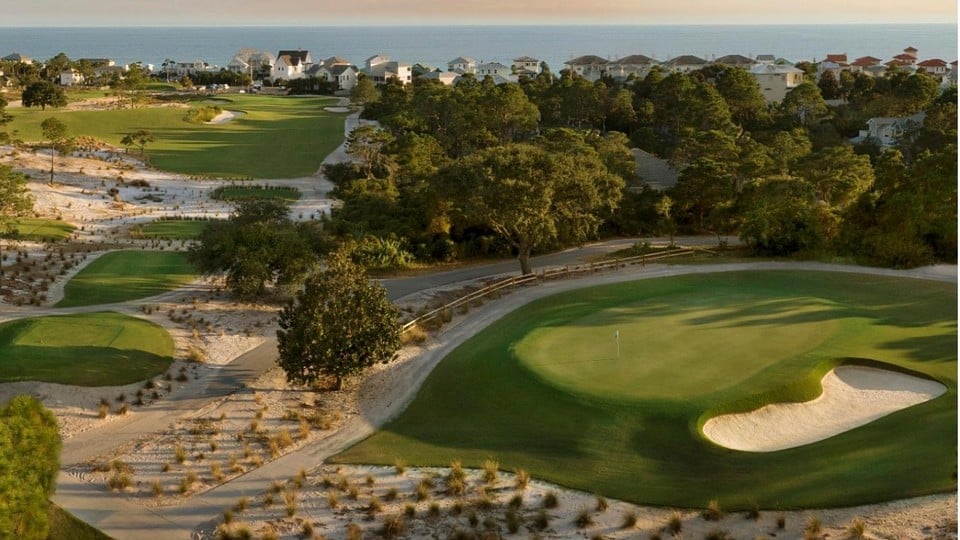
Ironically, it was my time as a teaching professional that truly informs my design. As a teacher, I became highly aware of the challenges most players face. We design golf courses that are quite challenging for elite players and totally manageable for every day players.
We allow people to successfully play the game on the ground and believe that green complex surrounds are key to interest, variety, and playability.
How challenging is it to design a course to challenge elite level tour professionals while still providing a fun test for those at the recreational level?
I think I just answered much of that question, but let’s go further. Big greens with loads of contour widen the already large gap between highly skilled and less skilled players. Elite players have such a high level of skill when putting, they can handle most challenges on the greens.
Average players miss both large targets and smaller targets regularly – therefore, we try and create more forgiving green surrounds for the recreational player, with smaller targets that grab the attention of the elite player. Set up can take our courses from a fun everyday experience to a tournament ready venue.
You were recently elected to be president of ASGCA. What’s the main goal you want achieve during your presidency?
I have been so fortunate to have grown up with the game of golf. My golf jobs ranged from picking range balls, caddying, playing tournament golf, handling golf shop operations and giving lessons. All along the way, I was exposed to a variety of lessons that apply to life skills.
As an architect, I have worked for US Kids Golf and First Tee facilities. Seeing the goals and positive impact these organizations have on youth has led me to believe the benefits learned through playing and working in the golf world are applicable to all. I truly believe that golf prepares people to better handle the ups and downs of life.
Is the USGA and R&A on the right pathway in regards to reining in golf ball and club technology? What letter grade would you give them now on the subject?
I believe they are.
No matter your skill or clubhead speed, a flushed golf shot sends the body and brain amazing feedback.
This does not change just because a player has more or less speed. It is so much easier to move up a set of tees than it is to retrofit a course on property that has been used to its maximum limit.
I am not fully current on the status of the roll back, but it seems like things might be on pause. I’d give them an A for plan and a C for execution.
Is it likely bifurcation happens — curbing distance gains for the elite level players and leaving alone those at the recreational level?
I fully support bifurcation.
The gap between the elite player and the fine club level golfer has never been greater.
We do not play the same game!
If you could change one thing in golf unilaterally – what would it be and why?
I would create more affordable, entry level, golf facilities of all types.
Creating quality golf experiences in smaller bites has great appeal to me.
I do not want the benefits I see from the game to be limited to mostly those with time and means.

Can the golf world and those closely connected on the environment side actually find common ground given the urgency the sport faces in the years ahead?
Golf seems to be an easy environmental target, especially from non-golfers.
As we continue the work to become less water and chemical dependent, we need to communicate progress and highlight our community benefits with regard to green space, air quality, storm water management, and physical well-being. We also create and/or preserve valuable wildlife habitat.
As a grandparent to four children, I enjoy collecting and sharing wildlife images seen live during my site visits. It is such a pleasure to send photos of bear, deer, bobcat, raccoon, snakes, iguanas, alligators, rabbits, beaver, and a tremendous variety of birds and water fowl, just to name some. Golf courses are sanctuaries.
Best advice you ever received — what was it and who was it from?
From Jim Treadwell – “The most valuable aspect of hard work and earning money is that it buys time. Time with your family, time with your friends, and time to pursuit and experience the things that bring you joy.”
Jim was an entrepreneur who sponsored me when I started playing golf professionally.
***
For more info on Bergin Golf, click HERE.

Related: Jared Lucero Interview

M. James Ward
A long-time member of both the GWAA and MGWA. The 68-year-old has covered all facets in golf since 1980 — including reporting on over 100 major championships and 13 Ryder Cup matches. His writings have appeared in various outlets. On a personal level, has played over 2,000 courses globally and is lead reviewer for Top 100 Golf Courses.
Previously served for 17 years as national course rating panelist for Golf Digest. Has also personally competed in USGA Championships. Resides in the metro New York City area with his wife Celeste. Favorite quote paraphrased for golf — “You are what your golf score says you are.”