
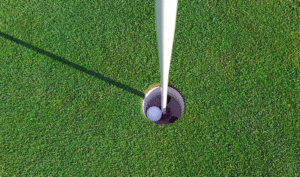
Every club has the story. Someone’s playing partner pured a 7 iron at the 14th, watched it take two bounces and vanish, and has been buying rounds at the 19th hole ever since. The celebration is loud because the odds are brutal, and most golfers will go a lifetime without finding out how it feels.
That fascination with long shots is not limited to the fairway. Some golfers who enjoy the arithmetic of rare events end up wondering how a game of pure chance compares, and a look at UK slot sites shows a very different kind of maths, one where skill plays no part and the odds sit in plain sight on every game.
How rare is an ace, really?
The figure most often quoted comes from the National Hole in One Registry. According to PGA.com’s breakdown of golf’s unlikely shots, the average golfer has a 12,500 to 1 chance of making a hole in one, a tour player is closer to 3,000 to 1, and a low handicapper sits at 5,000 to 1.
The same source reckons an ace turns up roughly once every 3,500 rounds in the United States, and that the average handicap of a golfer who makes one is 14. That second number is the encouraging one. Nobody needs a scratch game to get lucky on a par 3, though the better player does get more chances of it going their way.
Skill matters here. Swing a club more cleanly, hit more greens and you shorten your own odds a little. That is the first big difference between golf’s long shots and games where the outcome is generated by a computer.
Where a slot’s numbers work differently
An online slot has no swing to improve. Each spin is settled by a random number generator, and the result of the last spin has no bearing on the next one. A game that has not paid out for fifty spins is no more “due” than a golfer who has not holed out for fifty years.
What a slot does publish is its return to player, or RTP. A game listed at 96% is designed to pay back an average of £96 for every £100 staked, but that average is worked out over a vast number of spins, not over an evening. The UK Gambling Commission makes the same point in its own guidance on gaming machines: RTP is an average over a significant number of plays and says nothing certain about any single session.
So a golfer weighing up the two will notice something odd. The hole in one odds are an estimate built from insurance claims and tournament data, and they shift with your handicap. A slot’s RTP is set by the game’s design, it does not move with the player, and the short run can still look nothing like it. Volatility, meaning how big and how often the wins land, explains why two slots with the same RTP can feel completely different.
Why the rare feat still makes the paper
Golf has always loved a number nobody expected. Golf Today’s own record of 16 sub 60 rounds in PGA Tour history is a good example: Michael Kim became the latest in July, when he shot 59 in the second round of the 2026 3M Open at TPC Twin Cities. Sixteen rounds across the whole history of the tour tells you how thin the air is up there.
The pull of those moments is the same pull that keeps people watching a lipout. The feat is rare enough to be memorable, and ordinary enough to feel possible. That mix is exactly what makes long odds easy to misjudge. A golfer who has seen three aces at his own club can start to feel they are common. They are not. The 12,500 to 1 figure does not care how many your friends have made.
Reading the odds like a golfer
Golfers are, as a group, decent at living with variance. A birdie putt that lips out is shrugged off, a duff chip after a perfect drive is part of the deal, and nobody sensible changes their whole swing because of one bad round. That habit transfers well. A figure like RTP, or a published hole in one price, is a description of the long run, and the long run only shows up after a lot of attempts.
It also helps to keep the two kinds of luck apart. In golf, practice moves the needle. In a slot, nothing you do changes the odds, so the only sensible way to treat it is as paid entertainment with a known cost, set against a budget decided before you start.
The next time someone at the club bar claims their ace was “bound to happen eventually”, the numbers are on the side of the sceptic. Twelve and a half thousand attempts is a lot of par 3s. Most of us will hit a great many of them without the ball ever dropping, and the round will still be worth playing.

Andy Newmarch
Being one of the original owners of the ‘Top 100 Golf Courses’ website enabled Andy to travel far and wide playing and rating courses, with the numbers somewhere around 1200 courses in 40 countries. Although now away from the day-to-day grind of course ranking, having a keen eye on course developments is still high on the agenda. Currently hanging on to a handicap index of 8.1 he is probably as competitive on the course than ever but more often than not will compliment this by relaxing at the 19th hole to make up for the hard work!