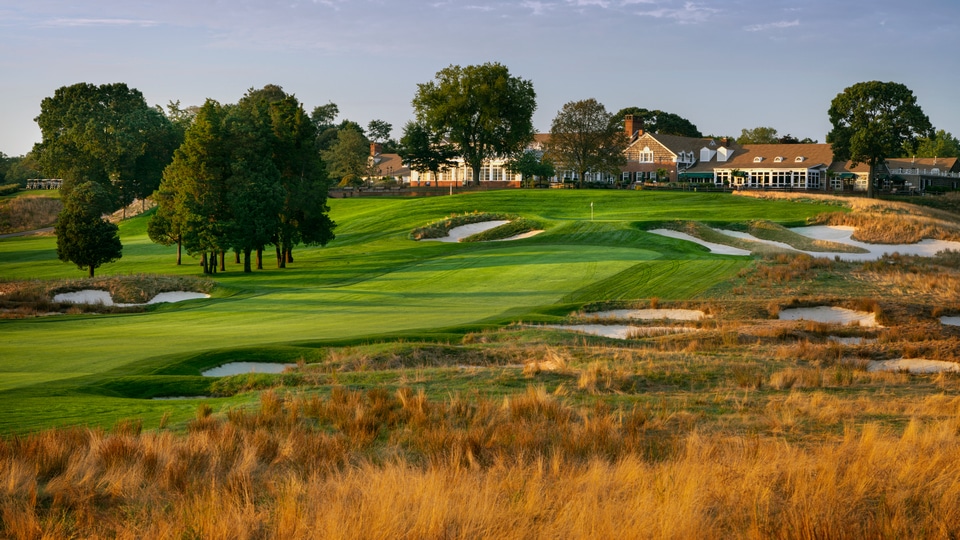
FARMINGDALE, NY. The 45th Ryder Cup matches commence this Friday, and at the centre of the stage will be the renowned Black Course at Bethpage State Park.
The A.W. Tillinghast layout was the first government-owned facility to host the US Open in 2002 and did so again in 2009, with Tiger Woods and Lucas Glover winning respectively. The PGA Championship arrived in 2019 with Brooks Koepka keeping possession of the Wannamaker Trophy. Now the ultimate team competition in golf arrives.
The involvement of architect Rees Jones was a key element in transforming the Black Course from total neglect to a shining star. Jones took on the task pro bono and beefed up the layout to provide a stellar test of golf, culminating with the sport’s premier player — Woods — winning and being the only player to finish under-par at the ’02 US Open.
The 84-year-old architect has been instrumental in resurrecting a number of classic courses which have hosted past US Opens and PGA Championships. Rees inherited the tagline, “The Open Doctor,” from his renowned father, Robert Trent Jones Sr., who excelled in bolstering a number of classical courses in challenging the world’s premier players.

The Rees Jones Story
Rees Jones was born into the game of golf. He learned to play as a youngster, competing as a junior golfer, in college and while in the army. He grew up traveling with his family to golf courses all over the world and worked in the summers for his father, renowned golf course architect Robert Trent Jones Sr.
He has designed or renovated more than 270 golf courses in his career, having developed his own style of timeless design.
His renovation and restoration skills have been applied to seven US Open venues, nine PGA Championship courses, five Ryder Cup and two Walker Cup sites as well as three Presidents Cup venues.

***
Before your involvement ramped up Bethpage, what did you know of the facility generally and the Black Course specifically?
I knew that Bethpage Black was a championship facility capable of hosting championship events.
What I didn’t know until I visited on May 1, 1995, was that it was in such ill repair.
When you visited the Black Course for the first time, what was the general impression and the most enduring aspect?
It was a well-routed golf course on a natural site.
I knew it could be brought back to life with a restoration and modernisation. I also saw that Tillinghast’s design elasticity gave us the opportunity to bring it into the 21st century.

What specific role have you played in the preparation of the Black Course for this year’s Ryder Cup matches?
We have worked with Kerry Haigh on any changes that were made prior to the Ryder Cup. A new tee for the opening hole and a revised bunker on the 13th.
The 5th fairway bunker was refurbished, and the floor at the far end was slightly widened. The fairway chipping area behind the 14th was converted to roug,h and the 10th fairway was widened.
Will the course play differently for the matches versus when the course hosted the ’02 and ’09 US Opens and 2019 PGA Championship?
The course will play differently for the Ryder Cup than it did for previous championships. The rough adjacent to the fairways will be 2 1/2 ” and the greenside rough will be 3″ inches.

If you had to choose a hole from the front and back nines for the sheer complexity of the challenges provided, which ones would you choose and why?
There are many challenging holes at Bethpage Black. On the front nine, the 5th may be the most challenging because the tee shot must stay right and the naturally elevated green is heavily protected with bunkers.
On the back nine, the 15th will be the most demanding. The tee shot must stay on the fairway, and the green contour is the most severe on the golf course. Accessing the hole locations in the back will be difficult.
Given the match-play format of the Ryder Cup, do you see certain holes being altered in terms of tee location? As an example, the opening hole will provide players with the option of going for the green by cutting the corner.
Bethpage Black can be played as a total yardage of 7486. However, for the Ryder Cup, Keegan Bradley will choose the yardage for each hole. The new tee on the opening hole will provide many shot options for the drive. A player can play safe to the left or flirt with the trees and hit closer to the green.
The 4th hole can definitely be hit in two from the back tee, and the 13th hole will most likely be set up with the yardage that allows the competitors to go for the green in two. Holes 15 and 17 will be played shorter than designed because of the stands. My understanding is that yardage will vary with daily set-up, but the total yardage each round will generally be between 7350 and 7400. Par will be 35 / 35 = 70.

How do you think A.W. Tillinghast would view the Black Course in contemporary 2025 terms?
A.W. Tillinghast left us an opportunity to lengthen the golf course and make the necessary changes to bring it into today’s golf championship world.
He would be very pleased that the golf course has held up over the years. It has definitely stood the test of time.
Does the Black reward a certain style of play?
The Black is both strategic and penal. The aerial game will be played predominantly by the Ryder Cup competitors. Hitting the fairways will be beneficial because the tee shots will get a lot of rollout.
Hitting the rough off the tee will lengthen the second shot and make the greens harder to hold due to reduced spin. Bethpage Black is different from any other Tillinghast design because it was the 4th course he built at Bethpage State Park.
He had the opportunity to build the ultimate championship golf course, which is more penal in style than any of his other designs.

Among the Tillinghast courses you have visited/played – where would you rank the Black among them?
The Black is probably the supreme championship golf course that A.W. Tillinghast designed.
He was renowned for building many championship tests that have stood the test of time. I would rank Black as the Tillinghast ultimate design. He had this opportunity because he built 3 other courses at Bethpage State Park for the everyday player to enjoy.
There’s been discussion that the Black is a joint creation between Tillinghast and lead on-site construction manager Joseph Burbeck. What’s your take on the genesis of the layout?
There has been a discussion as to who the true course architect originally was. From what is evident on the ground, it is definitely an A.W. Tillinghast design.
Joseph Burbeck was the on-site construction manager who obviously followed the Tillinghast design principles but may have incorporated some of his own ideas while he was in the process of construction. No great golf course is created alone — it takes a team.

The USGA and R&A have jointly announced that a golf ball rollback will happen in 2028 for elite players and for all others 2030. What’s your take on that planned action?
I have no crystal ball as to how the rollback will affect the elite player’s game. It will affect the game of each player differently.
We also have no idea how the manufacturers are going to respond.
What’s the most challenging aspect in creating a “new” layout versus an “existing” one?
When creating a new layout, the routing must be created from scratch, and as trees are cleared and the land reveals itself, adjustments often need to be made. A new course requires the architect to make adjustments throughout construction.
When you redesign an existing layout like Bethpage Black, you know early in the process what needs to be done, and far fewer design elements change from the outset. You can see what you have to do initially.
Your father was an instrumental figure in elevating the profile of a golf course architect. How does your style both complement and diverge from his?
My father, Robert Trent Jones, elevated the profile of golf course architects when he made the major changes at Oakland Hills for the 1951 US Open. From the mid 50s until now, golf course architects have received more recognition for upgrading golf courses for major championships.
My father’s style in many cases was patterned after Augusta National and required an aerial game. My style is to allow both the ground game and aerial game, giving players of all skill levels the chance to succeed on the golf course.
I like to create shot options and opportunities for shorter hitters, ensuring that the layout is both accessible and challenging. I also stress the importance of providing an achievable recovery shot.
When people look at the length and breadth of your career, how do you wish to be viewed?
I’ve been very fortunate to have the opportunity to work on many major championship golf courses that required upgrading. I’ve also had the opportunity to build new courses on very special properties.
I would like to be known as the architect who adapts thoughtfully to the given assignment. Every project requires a unique approach in order to be successful.
Above all, I want to be known as an architect who truly appreciates how the game is played by golfers of every calibre.
Final question – which team emerges victorious when the matches conclude?
I believe the US Team should win because the Bethpage crowd will be the best and most boisterous crowd ever for a Ryder Cup match. The fans should be considered the 13th player on the team.
The atmosphere created by the fans should give the American team the edge.
***
For more info, go to:

Related: Scottie Scheffler Tuesday press conference