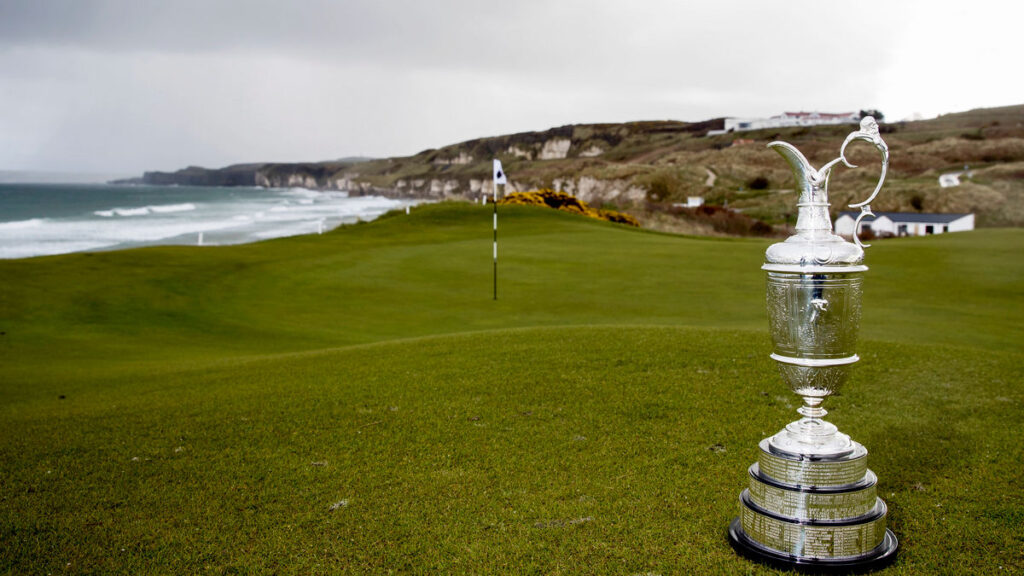
7,381 Yards / Par-71
Architect: H.S. Colt (1933) / Martin Ebert (2015 updating)
Portrush, Northern Ireland
Since its foundation in 1888, Royal Portrush Golf Club has undergone a transformation in more ways than one. Originally a 9-hole course, known as the County Club. The following year it was extended to 18 holes.
In 1892, the name changed to the Royal County Club, with the Duke of York a patron. In 1895, the Prince of Wales came along and the name changed to Royal Portrush. No one definitively knows why.
The biggest transformation came when Harry S. Colt redesigned the course in 1933 — including two holes in an area known as “The Triangle.” Just before WWII, when it became apparent the clubhouse would have to be relocated, the professional at that time — P.G. Stevenson — designed the 10th and 11th holes, allowing the old 1st and 18th in the Triangle to be released. It would take until 1946 though before the club moved to their present premises, the former Holyrood Hotel.
The Dunluce Links is named after the ruined Dunluce castle that overlooks the course. It was the venue for the first professional golf tournament in Ireland won by Sandy Herd in 1895.

In 1951, Royal Portrush became the first club to host The Open Championship outside of Scotland and England. Max Faulkner was the champion then. Faulkner would be the last from the UK to hoist the Claret Jug until Tony Jacklin won in 1969 at Royal Lytham & St. Annes in England.
In 2014, the R&A confirmed Royal Portrush to once again serve as the venue for golf’s oldest major championship in 2019.
Royal Portrush displays rugged links beauty and it has one of the most dramatic entrances to any golf course. As you wind your way towards the course along the coastal road, the crumpled, undulating links land suddenly appears in front of you, flags fluttering in the breeze.
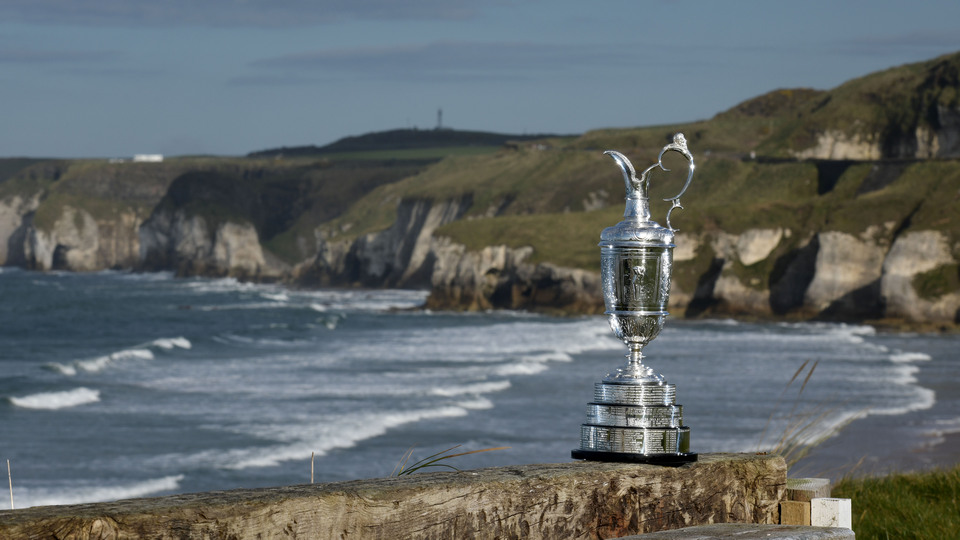
It’s a classic seaside links, located in an evocative setting on the north Antrim coastline, blessed with magnificent ocean views. On a clear day — from the 3rd tee — you can see the Paps of Jura and the island of Islay.
The fairways nestle in natural valleys between towering sand dunes. The small greens blend perfectly into the landscape, one of Colt’s masterstrokes. The greens are generally protected by natural grassy hummocks rather than sand bunkers, further adding to the understatement.
Among the host courses for The Open, Royal Portrush has a limited number of total bunkers — 59. However, the ferocity is more than able to befuddle and cause consternation for those failing to heed their presence.
The most spectacular parts of the course are down by the shore. The 5th hole — called “White Rocks” — is an absolute stunner. It’s a short, downhill par-4 with a left to right dogleg. The elevated tee provides a platform to soak up the vista. The green is perched on the very edge of the course some 50 feet above the seashore. The 16th, called “Calamity”, has been extended to a 236-yard par-3; a deep chasm to the right of the green makes it a nervous tee shot but there is a frontal alleyway that can be used by players to feed the ball onto the green.
In preparation for the return of the 2019 Open, architects Mackenzie & Ebert proposed a number of course changes, the most significant of which was the replacement of holes 17 and 18 on the Dunluce with two new holes, located where the old 5th and 6th holes lay on the Valley Course.
The new hole 7 is a par-5, played over much of the former 6th on the Valley Course, but in the opposite direction. The famous “Big Nellie” bunker from the old 17th on the Dunluce has been recreated in the dunes to the right of this new fairway.

The new par-4 8th is then played from close to the tee boxes on the old Valley hole number 5, back to a green perched in the dunes at a slightly higher elevation.
Although the four par-3s remain untouched, except for mowing the green further out at the back of “Calamity Corner”, additional tees and bunkers at several holes have been added, as well as extending the greens at holes 5 and (the newly sequenced) 15.
Three architects — including Martin Ebert the man who updated Portrush — were asked to provide respective comments on what awaits the best players in the world.
At the end of the event only one man will take home the coveted Claret Jug and rightly be proclaimed “champion golfer of the year.”
***
Royal Portrush Golf Club Scorecard |
| 1ST / 420 Yards / Par-4 2ND / 575 Yards / Par-5 3RD / 176 Yards / Par-3 4TH / 502 Yards / Par-4 5TH / 372 Yards / Par-4 6TH / 193 Yards / Par-3 7TH / 607 Yards / Par-5 8TH / 434 Yards / Par-4 9TH / 432 Yards / Par-4 |
| OUT = 3,711 Yards / Par-36 |
| 10TH / 450 Yards / Par-4 11TH / 475 Yards / Par-4 12TH / 532 Yards / Par-5 13TH / 199 Yards / Par-3 14TH / 466 Yards / Par-4 15TH / 429 Yards / Par-4 16TH / 236 Yards / Par-3 17TH / 409 Yards / Par-4 18TH / 473 Yards / Par-4 |
| IN = 3,670 Yards / Par-35 |
| TOTAL = 7,381 Yards / Par-71 |
***
Q & A
Define links golf?
Paul Kimber: In a word — heaven! Links courses must have sandy soil in tandem with fast fine fescue turf and undulating ground naturally shaped by the wind – or at minimum replicated to appear that way. Links golf is also exposed to the ever-changing nature of variable wind patterns.
There also needs to be green complexes designed for the ‘ground game’ with running as well as lofted approach play.
Martin Ebert: Links golf is played over a fine, fescue dominated grass sward with free draining sand underlying the turf. As a result, links golf enjoys the firm bounce of the ball, making it a skill to be mastered in three dimensions rather than two. That makes positioning the ball so important.
It is the tight resilience of the fine grasses which makes the contact between club, ball and turf so different to that which is found inland. It is putting from miles out if you want to. It is the honest wind which can make the challenge both testing and fun at the same time. There is a naturally induced thrill in hitting shots downwind, against or with a cross wind and even into the wind when the flighting of the ball is so important.
It is the wide range of links landscapes which seaside golf enjoys. The links test can be set over the tumbling dunes of Ballybunion or The Island, the relatively flat but beautifully undulating courses of St Andrews, the sand blown over rock at Royal Porthcawl and Turnberry, the sandy hillscape of Gullane or the raw simplicity of dunes and marshes at Royal West Norfolk. All of them are links but all of them so different.
It is the severity of the bunkers and their range of styles from the most natural sand blow outs to the perfect art form of a man made revetted hazard.
It is simply the best terrain over which to play golf.
John Fought: Links golf is played on land that consists of sandy soils that is near the ocean or a river estuary.
It involves the most ancient of playing conditions with the grasses consisting of fescues, bents and ocean beach grasses.
To me it is where golf began and it is where golf was meant to be played. Its my favorite type of golf.

In your assessment where does the Dunluce Course at Royal Portrush rank when compared to other vintage links?
John Fought: Royal Portrush is not only a great venue with its true links heritage, the golf holes are dramatic and interesting. I am so glad the R&A has included this course in the rotation.
The holes test every element of your game and when the winds blow it is one of the most difficult for The Open. A very worthy and important venue.
Martin Ebert: Portrush is in the very top echelon of vintage links courses. The views are spectacular. Harry Colt’s original routing was inspired.
The necessary evolution of the layout just before the Second World War, in preparation for the clubhouse moving out of the town, and before The Open in 2019, to allow that great event to be played, has arguably strengthened it further.
The final characteristic which gives the Dunluce its magnificence, is the detail of the shaping of the all-important greens and surrounds. They provide some of the finest examples of links shapes in the game.
Paul Kimber: It has to be right up there in my top 10. It has special memories for me which always helps but when you analyze the course architecturally then it has some really strong points. Starting with the landscape, the size and most importantly scale of the dune system is perfect for links golf, similar to Birkdale, it’s got big enough dunes to affect the players senses but not so big that any of the holes become unwieldy.
For the layout and routing I love the fact that, unlike many of the other vintage links as you call them, the Dunluce is constantly changing direction rather than playing ‘out’ and back ‘in’. This means you never really settle on the wind direction and have to adjust shots accordingly. On an individual hole basis, it has a very strong collection of par 3s ‘Calamity’ will always get the attention, but the others are all exceptional.
Rather than thinking of signature holes I prefer to rate a course on its weaknesses and to be honest, on the Dunluce, I can’t think of any.
Updating courses can be a difficult assignment. Is the task more complicated when a classic links course is involved?
Paul Kimber: I wouldn’t say so, most of the courses we deal with have a history they are proud of, but they have come to us as they are looking for some form of change.
While we always look at that history, we try not to let that tie our hands. The game continually evolves, and courses should too.
As long as we respect the philosophy of the original design and apply that to the modern game we expect to deliver results that improve the course without feeling out of context.
Martin Ebert: In many ways it is, as being respectful of the heritage of the course and understanding its evolution is so important before thoughts can turn to making any proposals.
Once any changes are agreed, the focus then turns to ensuring that any new features blend in with the old. We have done our job well if golfers are unable to see the ‘join’.
The challenge is also magnified by knowing that the world of golf will be casting their opinions on the results.
John Fought: Updating a classic links is not as difficult as it may seem as long as the designer respects the natural elements of the site. Links are always natural and not contrived so a designer must carefully study the dunes, the wonderful topography and blend the need to keep everything natural while building the golf features.
Often designers have to completely grade native features to make the course work, on a links you need to embrace these features, even when they are a bit quirky which gives more freedom.

How important is the characteristic of patience when players are dealing with links golf?
John Fought: Nothing can be forced on a links as that is what can get a player in trouble. With wind and weather conditions par is only a number.
When playing a links, you must embrace different types of shots and be able to play bump and run when called for. Just because a hole is short does not mean it is going to be a simple birdie.
You must be creative and patient to take advantage of what nature provides.
Paul Kimber: Patience is required for any golf, and probably why my own game isn’t as good as I’d like it to be, but it is always essential in Links golf. The combination of undulating fairways, gathering bunkers and wind means unfavorable ‘kicks’ and lies will happen to everyone, as will favorable ones but everyone still has to ‘play it as it lies’.
As I’m trying to instill in my 15-year-old son, you can only affect your next shot so forget all the others, the patient players and the ones who stay ‘in the present’ will do well.
Martin Ebert: Probably more important for links golf than for any other form of the game.
The fact that the ball needs to be played along the ground as much as through the air means that some bounces will not provide assistance. That can lead to frustration and the need for patience.
However, the best strikers will normally prevail as their accuracy will reduce the dangers of an unfortunate bounce being experienced from the links undulations.
Give the R&A a grade for the manner in which host courses are prepared for The Open Championship?
John Fought: I think the R&A gets high marks for not making length the only barometer for scoring. Weather conditions often dictate the difficulty of the event.
I think the R&A understands this very well and tries to provide a test to determine the champion golfer of the year. I think they deserve an A.
Paul Kimber: I love The Open, and the way it is set up. Personally, to judge the ‘set up’ , I don’t look to the winners score I look at the cut mark, if the cut is around par then I think the difficulty is well positioned.
Let’s be honest we still all want to see some good high-quality golf with birdies and eagles and we might well admit a wry smile if there are a few big numbers out there. So, if the top 60 – 70 golfers in the world break par & make the cut I’d say the balance is about right. On that basis I’d have to give the R&A an ‘A’.
Martin Ebert: A+ for me.
The involvement of The R&A in the planning of any adjustments to the great links for The Open Championship is extremely well considered and thoughtful and made in conjunction and collaboration with the clubs and their advisors.
The R&A agronomists in the sustainability department are focused on delivering true links playing conditions given all of the constraints which may apply.
During the lead up to the event and the week of The Open itself, enormous care and attention is paid to tee locations, green speed and firmness and the critical hole locations, with the weather being such a key factor. That always produces an exam paper which is fair with the objective of delivering the “Champion Golfer of the Year.”

Is there any course that has never hosted The Open you would like to see stage the championship?
Paul Kimber: I’d look at the East course at Saunton in Devon. I’m not sure the roads in Devon could cope with the infrastructure but the course is excellent.
Martin Ebert: It is no secret Portmarnock will have a good chance of hosting The Open in the future. Everything about that great Club, its wonderful course and the enthusiasm which the Irish people will support the event makes it a tremendous prospect if this ultimate aim can be delivered.
Beyond Portmarnock, I would love to see The Open go to Wales and Royal Porthcawl. The course, with its sea views from every hole, is one of the very best and the Women’s Open being played there this year will bring it even more to the attention of the golfing world.
John Fought: There are a few including Royal County Down, Baltry (County Louth) and Portmarnock in Ireland. I also think Royal Dornoch, Royal Aberdeen and Sunningdale are worthy.
Is The Open Championship the consummate test among all of the four majors when weighing the totality of one’s golf game?
John Fought: The Open Championship is a wonderful historic event. It is played on ancient links courses which makes it a unique event.
All majors have their own personality but I think The Open is very important to the game of golf. The style of golf presented links us to the past and allows players to test their skills as many have for more than 150 years.
Paul Kimber: I have to say yes to that! With one caveat – as long as the wind blows…
Even a gentle 10 mph will be enough but generally to win an Open a player will have every facet of the game tested. From the patience standpoint already described and including high quality shot making, strategic thinking and positioning of one’s golf ball.
Martin Ebert: I believe that it is.
The fact that the elements, and the wind in particular, can provide such an added test of skill, makes The Open far more demanding of all aspects of shot making than other events played over non links landscapes.
And anytime that pitch and stop golf is not possible, the examination of technique and imagination is so much more searching.

Among par-3, par-4 and par-5 holes in Open Championship links venues – which course and hole would you pick for each of the par designations?
Paul Kimber: For the par-3 one has to select the 8th at Royal Troon – the Postage Stamp. The hole consistently creates a lot of drama in such a short distance.
For the par-4 – I’d select the 16th on the Old Course at St. Andrews. The hole is named the “Corner of the Dyke” and it’s not one you could build these days or replicate but the out-of-bounds is so tight down the right side and the bunker complexes of ‘Principals Nose’ followed by “Deacon Sime’ take the left fairway out of play so many gamble with getting a decent lie in the left rough, those that do successfully hit the fairway get a good advantage here.
I’d also mention the 18th at Carnoustie. There’s so much going on here and it is very difficult for the average player but always creates drama at some point during an Open.
On the par-5 side – I’d go with the 5th at Muirfield. The bunkering is exceptional, both from the tee and for any lay-up at the green. The tight, angled approach also means that to get on in two shots requires a very high degree of skill via well-executed shots.
Martin Ebert: On the par-3 side –the Postage Stamp (8th) at Royal Troon. No short hole induces as much fear in the players on the tee and more excitement from the crowd. At Portrush, Calamity (16th) would have to be the pick.
On the par-4 side – The Road Hole at St Andrews (17th). No other hole I know plays over a hotel, has a pathway, road and wall as major artificial hazards and the terrifying Road Hole bunker to avoid.
At Portrush, White Rocks (the 5th) provides a brilliant and beautiful example of a short par 4.
On the par-5 side – the 10th at Turnberry, played from its tee by the Lighthouse, arcing around the bay to its infinity green is, in my view, impossible to beat although the new 7th hole on the same Ailsa Course will provide stiff competition.
At Portrush, Curran Point (the 7th) plays down and up over an amazing dune landscape and dominates the first view that arriving golfers see of the course.
John Fought: For par-3s, I favor the 8th at Royal Troon — the Postage Stamp. What a wonderful delicate hole this is. The 4th at Royal County Down is a great long three.
For par-4s, I think the 17th hole — the Road hole at St Andrews is amazing. We could never build this hole today — over a hotel — but the green is so difficult that it rewards only great shot making.
I also love the par-4 17th at Carnoustie. It forces a player to play boldly.
For a par-5 hole it’s hard to beat the 14th aptly named “Long” at the Old Course at St. Andrews.
It makes you plan every shot on your way to the green but also provides alternatives.
***

Related: Round 1 Teetimes
The Participants
Martin Ebert
Director
Mackenzie & Ebert
West Sussex, England

Has worked in the golf course design business for 35 years and advised upon nine of the ten Open venues including Royal Portrush. This involved the redesign to the course and the changes, including two new holes, for The Open in 2019.
He has also recently worked on existing course projects in many parts of the world including the UK, Ireland, Australia, Canada, Spain, Peru, Chile, Argentina and Japan and is currently working on a wonderful new course project at Moncayo in Puerto Rico.
Paul Kimber
Partner, Kimber & Glen
Dunning, Scotland

Early development in his career spent working with David Kidd with sites ranging from Hawaii to St Andrews, with stops at Machrihanish and Fancourt.
Learned craft on-site, designing and building new courses as well as carrying out major renovation works.
Following the global financial crisis and the subsequent slowdown in the economy, ventured out on his own, establishing an office in the Home of Golf.
Since then, has secured commissions in both the UK and China. Clients have included some of the UK’s leading courses, such as Glasgow Gailes and Kilmarnock Barassie in the West, as well as working for the R&A at their test facility for Alan Robertson House at Kingsbarns in the East. Also led the construction of the highly regarded Dumbarnie Links.
Kimber’s work has been recognized by GEO as one of their inaugural Sustainable Design Champions. Additionally, he is an active member of the EIGCA and recently elected Vice President.
John Fought
John Fought Design / ASGCA Fellow
Scottsdale, AZ, USA

Culminated a successful college golf career at Brigham Young University by winning the 1977 US Amateur.
After graduating with a degree in accounting, he turned pro, joined the PGA Tour the following year and won two events in 1979. After several years, he turned to golf course architecture as a career, and in the late 1980s began working with Bob Cupp, eventually running a branch office in Portland, Ore. and serving as Cupp’s primary West Coast designer.
In 1995 he started John Fought Design in Scottsdale, Ariz. Some of his most recognized designs include The Gallery South Course in Tucson, Ariz.; Langdon Farms in Portland, Ore.; The Reserve Vineyards and Golf Club in Portland, Ore.; and Rush Creek in Minneapolis, site of a 1997 LPGA event.