

There is no golf quite like the golf that waits for you on the western edge of Ireland. Standing on the first tee at Lahinch, Ballybunion, or Carne with the Atlantic pressing against the dunes and a low grey sky dragging itself across the horizon, you understand — perhaps for the first time — what the word “links” really means. It does not mean a pleasant walk. It means a negotiation. A reckoning with something ancient and indifferent, and a course that will humble you, test you, and somehow leave you wanting more before you have even completed the first nine holes.
Ireland has long attracted golfers in search of authenticity, and the country’s sporting culture runs deep. From the Connacht coast to the Dingle Peninsula, locals who follow sport — golf, Gaelic games, football, racing — engage with it with a passionate intensity. That same culture has also driven explosive growth in online sports engagement, and for those curious about where to compare operators and odds, a range of sports betting sites in Ireland now provide comprehensive guides and reviews. But back on the fairway, it is the wind that commands attention — and the wind on the west coast of Ireland is a force entirely in its own category.
Why Western Ireland’s links courses are unlike anything else in golf
Links courses across the UK share certain qualities — firm turf, unpredictable bounces, exposed coastline — but the courses strung along Ireland’s Wild Atlantic Way represent the most elemental version of the form. Where parkland courses reward precision and reward those who execute their plan, western Irish links courses reward adaptation, resilience, and an almost philosophical acceptance that you are not in charge here.
Lahinch Golf Club in County Clare, founded in 1892, is the one that typically appears first in conversation. Known locally as the “St Andrews of Ireland,” it occupies a stretch of coastline where the Cliffs of Moher send Atlantic weather systems crashing inland with little ceremony. Bunkers seem to have been placed by the wind rather than any architect, and the routing rises and falls across dune ridges that were formed long before anyone thought to sink a flagstick into them. The goats that historically grazed the course and were said to predict weather by retreating to shelter before storms are now something of a legend — though experienced caddies at Lahinch will tell you they have their own instincts to rely on.

Ballybunion: The course that changed Tom Watson’s game
Further south in County Kerry, Ballybunion Golf Club occupies a position in golfing mythology that few courses anywhere in the world can match. Tom Watson, a five-time Open champion and one of the finest links players the game has ever produced, described it as one of the greatest tests of golf in the world. He was not being polite. The Old Course at Ballybunion is routed across a dramatic headland, with the Atlantic crashing against cliffs on three sides of the closing holes. There are no weak holes, no opportunities for a careless golfer to mentally switch off, and no mechanism by which form enjoyed on the front nine is guaranteed to transfer to the back.
The course demands that you read the wind — not just feel it, but understand it. A westerly at Ballybunion does not simply require you to aim left or right of your target. It rolls around headlands, reverses in pockets between dunes, and gusts through gaps in the rough with the specific intention of turning a well-struck shot into an unplayable lie. Locals who have played it for decades still profess to be surprised by it. That, fundamentally, is what makes western Irish links golf irreplaceable.
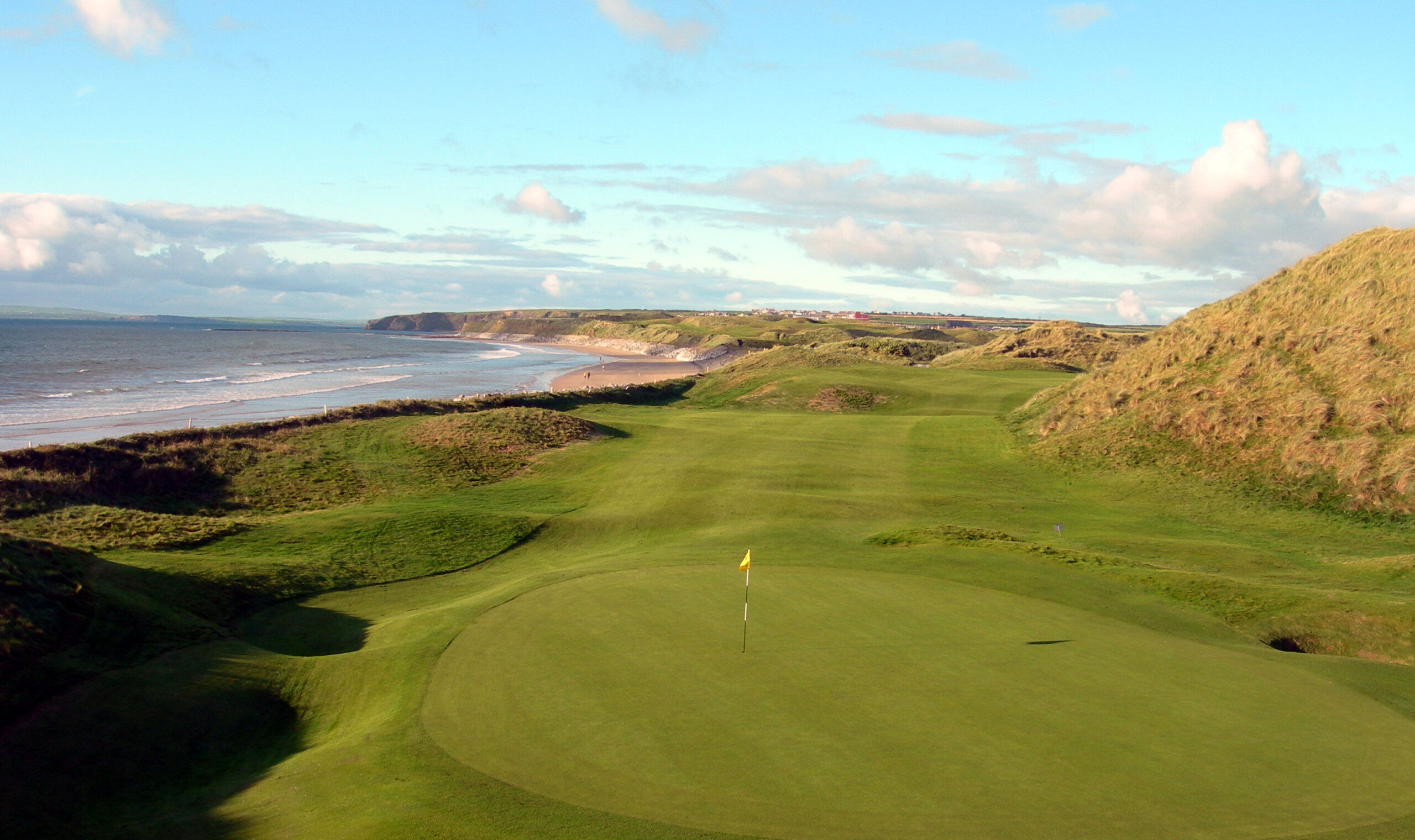
Carne Golf Links: Ireland’s hidden test on the Erris PeninsulaFor golfers willing to drive through Connemara and across the Erris Peninsula in County Mayo, Carne Golf Links represents something rarer still: a course of genuine world quality that has not been fully claimed by the mainstream golfing press. Designed by Eddie Hackett and opened in 1993, Carne sits on the Belmullet peninsula at the far north-western edge of Ireland. There are no hotels immediately adjacent, no gift shop doing a roaring trade in branded cashmere, and relatively few international visitors even aware of its existence.
What Carne offers is an unfiltered links experience. The dunes here are among the largest in Europe, and Hackett’s routing uses them not as obstacles but as the architecture itself. Several holes play from elevated dune tops with views across Blacksod Bay that have nothing to do with golf and everything to do with reminding the player that they are a very small thing in a very large landscape. A second nine, known as the Hackett Nine, was added later and features holes that many critics regard as among the most visually dramatic in Irish golf.
The psychological test: scoring and acceptance on an Irish links
One of the underappreciated aspects of links golf on Ireland’s west coast is what it does to the relationship between a golfer and their scorecard. On a calm day at a parkland course, a reasonable player can produce a reasonable round by executing shots they have practised. On a wild day at Carne, Ballybunion, or Dooks — the little-known gem in County Kerry that sits between the two giants — a reasonable player must abandon any attachment to a target score before the first hole is completed.
This enforced acceptance is, paradoxically, what makes the experience so rewarding. Golfers who return from western Ireland frequently describe their rounds not in terms of birdies or bogeys, but in terms of a hole played well in impossible conditions, a chip-and-run across hardpan that ended up inside three feet, a tee shot struck blind over a dune ridge that somehow found the fairway. The conversation moves away from handicap and towards something closer to the thing that made most people take up golf in the first place.
The off-course experience: food, culture, and the nineteenth hole
Western Ireland is not a destination where golf sits in isolation from the surrounding culture. Part of what makes the experience so complete is that the courses are embedded in communities where hospitality, conversation, and local food are treated as seriously as the golf itself. Clubhouses in the west tend towards the unpretentious: a pint of Guinness, a bowl of chowder, a match report on the television, and the kind of extended post-round analysis that can last longer than the round itself.
Towns like Westport in County Mayo and Killarney in Kerry serve as natural bases for multi-course itineraries. Westport in particular has undergone something of a quiet renaissance as a destination, with independent restaurants, craft producers, and a lively traditional music scene that ensures evenings are as engaging as the days on the course. According to Tourism Ireland, overseas golf visitors to Ireland represent one of the highest-spending segments of inbound tourism, with the west of the country consistently performing as the most visited region among dedicated golf travellers.
Planning a links golf trip to Western Ireland: what you need to know
Unlike golf destinations built around resort infrastructure, the west of Ireland rewards those who plan in advance but remain flexible in execution. Tee times at Ballybunion and Lahinch are in high demand between May and September, and booking three to six months ahead for peak season is not excessive. The courses themselves are typically open year-round — links turf drains quickly and Irish winters, while frequently wet, are rarely cold enough to close a course — but the most reliable weather windows are April through October.
- Ballybunion Golf Club (Old Course): Book well in advance. Priority visitor slots typically open around six months out.
- Lahinch Golf Club: A caddie is strongly recommended — local knowledge is a genuine competitive advantage on a course of this complexity.
- Carne Golf Links: Arguably the best value links golf in Ireland per round, and one of the most rewarding days you will have on a course anywhere.
- Dooks Golf Links: Often overlooked, consistently underrated, and set against a backdrop of Dingle Bay and the MacGillycuddy’s Reeks that is simply impossible to beat.
- Old Head Golf Links, Kinsale: Not technically west coast, but worth the detour — a clifftop course on a narrow peninsula that is unlike anything else in world golf.

Accommodation choices range from the practical — guesthouses in Belmullet or Ballybunion with early breakfast service built around golf timetables — to the more indulgent country house hotels of County Kerry. The roads connecting these courses are part of the experience: the Wild Atlantic Way drive between Lahinch and Ballybunion, cutting through the Burren and along the Shannon estuary, is one of the finest road journeys in western Europe.
The soul of it: why golfers come back
Ask anyone who has played Ballybunion or Carne in a proper Atlantic swell what they remember most, and they will almost never name a specific club or a specific number. They will describe a moment: the feeling of a 3-iron struck properly into a 40-mph headwind that bored through the air and landed somewhere near the flag. The sound of the Atlantic behind the ninth green at Lahinch while the rest of the field is still somewhere back on the course. The way the light in the late evening on the Erris Peninsula turns the dune grass into something that looks like it belongs in a painting rather than a golf course.
Western Ireland does something to a golfer’s understanding of what the game is for. It removes the artifice — the laser-measured distances, the perfectly groomed surfaces, the identical conditions from hole to hole — and replaces it with something older and more honest. The game here is between the player and the elements, and the elements are not going to make concessions. That is not a sales pitch. It is simply what happens when you play golf on the edge of Europe, where the last thing before the American coast is 3,000 miles of open Atlantic, and the wind knows it.
For golfers who have spent their careers on courses where predictability is a virtue, a week on the west coast of Ireland is not a holiday. It is a recalibration — of expectations, of methods, and of the reasons for playing the game in the first place. And for most who make the trip, it produces an addiction that no other destination quite satisfies in the same way.
For those researching the best courses to include in a western Ireland golf itinerary, Tourism Ireland’s official golf hub provides destination guides, course listings, and seasonal travel advice covering the full Wild Atlantic Way golf corridor.


Andy Newmarch
Being one of the original owners of the ‘Top 100 Golf Courses’ website enabled Andy to travel far and wide playing and rating courses, with the numbers somewhere around 1200 courses in 40 countries. Although now away from the day-to-day grind of course ranking, having a keen eye on course developments is still high on the agenda. Currently hanging on to a handicap index of 8.1 he is probably as competitive on the course than ever but more often than not will compliment this by relaxing at the 19th hole to make up for the hard work!